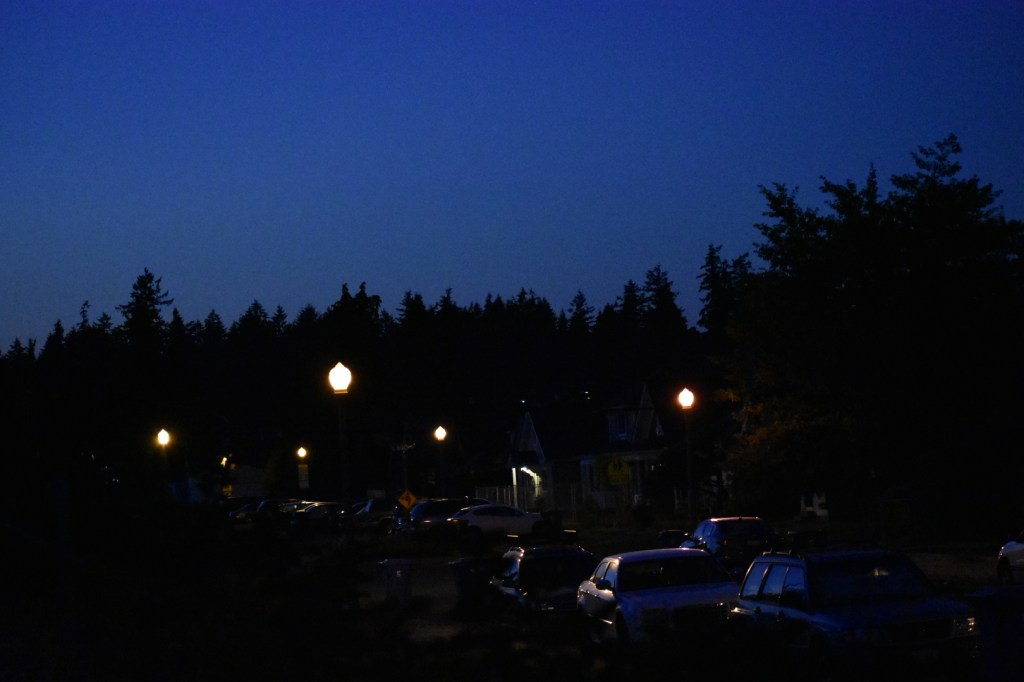
It’s six a.m. and blue this time of day this time of year. It reminds me of when I used to take moonlight walks as a boy, in Montana. Green creek pitch black. White ditch grass gray. Alfalfa as purple as its flowers. Fence posts silhouettes. That kind of blue.
The moon.
That kind of sleepless.
I’ve been up since four.
Scent on the air is SpaghettiOs and new puddles. Somehow stronger than the granary. Fast food bags and cans in the alleys, they haven’t seen water in months, so they have a lot of original scent to release when they get wet. This morning it’s mostly tomato puree.
I check my phone. The weather has no idea it’s been raining.
It’s been said of Wallace Stevens that if you put aside his personal life he was a very happy man. Maybe if you put aside his professional life, too. And maybe his art? I forget. My art hasn’t made me happy. But I don’t think it’s supposed to. I haven’t read much lately. That makes me sad, that I haven’t. I’ll begin again with Stevens when I begin again.
A man’s been following me. On this walk. Taking every turn I take. Warner, 62nd, Puget Sound, 56th, crosswalk, jaywalk, tomato alley. If I stay on South Tacoma Way, though, near the businesses on 56th and in streetlight, I don’t feel too menaced. Sure, the businesses are closed, a hundred dollars says no one’s inside setting up, either, but there’s something about storefront windows that make you feel protected from criminals. They make you feel watched. Like a mirror, or a Ring camera, or crucifix.
I’ve been followed before. This is a new man, but I’ve been followed here before. It’s that kind of neighborhood. It’s not something I worry about.
I’m not worried.
I did see this man once going through my recycling, now that I get a look at his reflection. I asked what he was looking for, I remember. He said, cans, I remember. I asked him if there’s somewhere you can take cans for money. He didn’t answer. I don’t assume there is. But before I could get my front door closed, he spoke again, said for twenty dollars he could show me the spot. I said, you can just tell me the name. He said, what name? I said, can you take cans somewhere in exchange for money? I don’t think that’s a thing anymore. He didn’t answer, again. Probably insulted. Then he stopped everything he was doing and rolled his head in a circle and grunted six times, like that thing I do a lot, and he tapped a can on the corner of my recycling bin and he was struggling to snap out of it. I grunted a couple times out of empathy. Moved but not moved moved. Moved like you’re thinking is a different moved, it’s sympathy’s job.
I’m full of empathy. That might be why I’m sad.
My dad and my brother and I used to go to a recycling center in a scrap metal yard outside Bozeman, Montana. We toted our aluminum cans there in five-gallon buckets in the back of my dad’s Chevy. Months’ worth of cans. I was just a kid, the buckets were heavy to me. We made them dense with the cans by crushing the cans the morning of. We’d kink the cans and fold them sort of and drop them on the ground and crush them the rest of the way with our feet. It was satisfying. Like standing around by yourself tossing snap pop firecrackers at trees.
At the recycling center the workers would lift us up so we could pour our buckets out directly over this crusher machine that pinched and squeezed the cans into tortillas. We weren’t supposed to be there, directly above the crusher like that, the tape on floor indicated as much, but the workers were holding us tight with their huge hands up there and laughing at us, so awed by this machine and giggling, and my dad looked so happy, too, and who could follow the rules of tape on the floor at a time like this?
When the last bucket was empty and the last cans were super-crushed a lady with a mullet perm gave my dad a slip of carbon paper on which she’d scrawled a number she’d thought of and written down. My dad handed it to me. It was a weight. It occurred to me none of us had weighed anything, did we?, but I never asked how the figure was arrived at.
My dad swung my brother away like an airplane and I followed with the paper to a man in a room with a cash register. There was a fine metal dust over everything in that room. Countertop, soda machine, every inch of floor, faded Makita posters with swimsuit women on them. You could see finger smears in the machine oil and grease and exhaust and steam that trapped the dust against the walls. The man gave my dad money from the cash register and turned a dollar of it into quarters, as requested, so my brother and I could pick a pop apiece from the pop machine.
We were told we’d earned it.
Tracks Out of Service
My man leaves me near the bikini coffee stand by the granary. He takes position across the street from it beside a dumpster and squats, eyes rapt like on a movie screen after you’ve taken a piss and you’re sitting back down and trying to catch up to the plot. This is that spot he was talking about, that he’d wanted twenty dollars for. I know because my dog peed on this dumpster once at four a.m. and my eyes naturally panned to the bikini coffee shack while he was urinating and a woman was in there pulling her sweater off and was topless beneath. It was only a silhouette I caught, and briefly, but I swore I could see glitter and a tan line and smell shea butter.
I say good morning to my man and I cross the street to the dumpster.
Nothing.
I double-check the angle. You can indeed see past the shack’s privacy screen from here. But the window shade is drawn. The shack’s open for business.
This is the spot, huh?
Nothing.
There’s a customer driving up to the window and I take this as my cue to leave as fast as I came. Three peepers is a crowd if only one’s paying.
Before I go I hold out a JFK dollar that’s been serving in my pocket as a lucky coin for three months.
All I got is this, I say.
He does that thing with his head and neck again when he takes it. Maybe trying to determine what kind of quarter the dollar is.
Morning’s here.
Sun and everything.
I walk to the railway crossing on the other side of the granary. There’s conflicting signage at the crossing. Suicide Prevention Lifeline 1-800-273-8255 and Tracks Out of Service. I have thought about lying down on these tracks. Walking sixty paces or so down into a thinned out paper birch and dogwood grove and lying down and waiting for nothing to come. But I can’t do it.

 todd of tacoma